

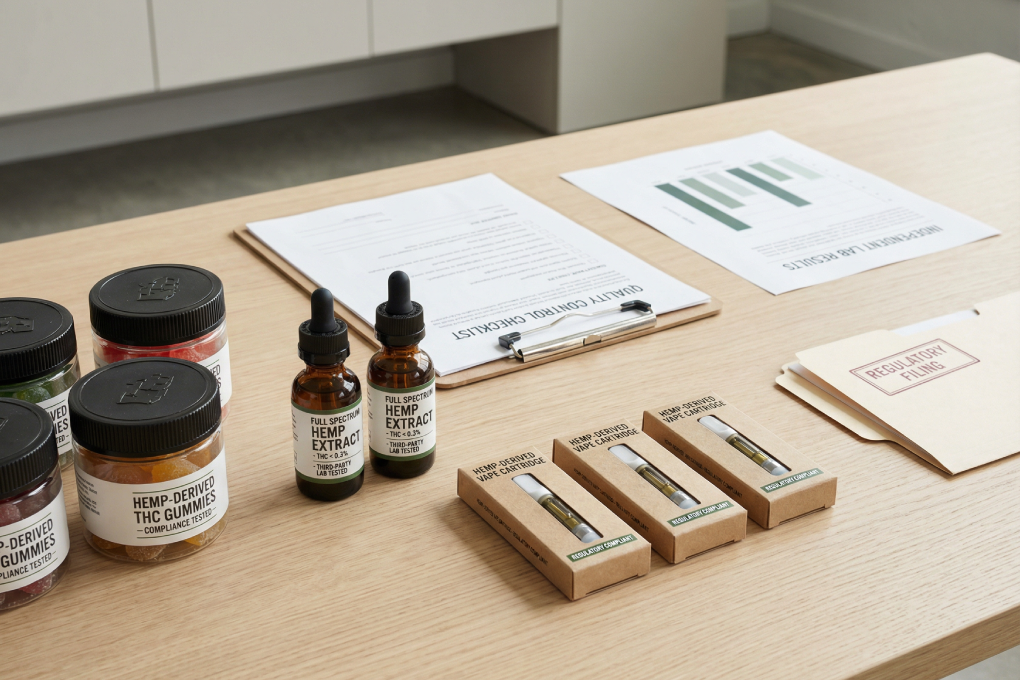
Hemp-derived THC products like delta-8 THC, hemp delta-9 THC edibles, HHC (hexahydrocannabinol), and high-THCA “hemp” flower have surged in popularity since the 2018 Farm Bill legalized hemp. These products exploit a loophole by using hemp (cannabis with very low delta-9 THC) to produce or derive intoxicating compounds that mimic marijuana's effects. Consumers have been able to buy delta-8 gummies, THC-O vapes, and other novel cannabinoids online or at gas stations in many states – often with minimal oversight. However, 2026 brings major changes to the legal and regulatory landscape for these hemp-derived highs. Lawmakers and regulators are closing the loopholes, and new rules are poised to redefine what's legal. Here's an up-to-date look at what's happening, why it matters, and how it impacts consumers.
After hemp was federally legalized in 2018, entrepreneurs discovered they could extract or synthesize other forms of THC from hemp CBD – most notably delta-8 THC. Delta-8 is a cannabinoid with psychoactive effects similar to traditional delta-9 THC, but it wasn't explicitly banned under the 2018 law. As a result, a nationwide gray market for “legal high” products quickly emerged. Gummies, vape cartridges, chocolates and even beverages boasting delta-8 (or delta-10, THC-O, etc.) popped up for sale outside of state-licensed marijuana dispensaries. In addition, producers marketed hemp-derived delta-9 THC edibles that technically stayed under the 0.3% delta-9 limit by weight but still packed a significant THC dose per serving.
This loophole created a booming market – by some estimates reaching billions in sales – but also raised alarms. Products were often sold with no age restrictions or lab testing, and reports of accidental poisonings and adverse reactions began to climb. America's poison control centers have documented over 10,000 exposure cases related to delta-8 and similar products since 2021, with more than half of those incidents involving kids or teenagers. Many of these edibles and candies were packaged to look like popular treats, which led to children unintentionally ingesting them. Health authorities and experts warned that unregulated hemp THC products may contain dangerous contaminants or inconsistent doses. By 2023, the U.S. Food and Drug Administration (FDA) had issued multiple warning letters to companies marketing delta-8 THC foods, citing serious safety concerns: these products are not FDA-approved, have psychoactive and intoxicating effects, and often use unsafe manufacturing processes and kid-attracting packaging. In short, what started as a legal loophole turned into a public health worry and a regulatory blind spot.
The turning point arrived with new federal legislation that significantly tightens the definition of legal hemp starting in late 2026. In late 2025, Congress passed (and President Trump signed) an agriculture appropriations law – effectively an early “2026 Farm Bill” update – that amends the 2018 hemp rules. Under this law, hemp is no longer defined solely by delta-9 THC percentage. Instead, the limit of 0.3% THC now applies to the total THC content of the product, including all THC isomers and precursors. Critically, the law also imposes a new per-product THC cap: any final hemp-derived product cannot exceed 0.4 milligrams of total THC per container. For perspective, 0.4 mg is virtually negligible – far below the amount in a typical delta-8 gummy or hemp THC vape. In effect, this change will ban most intoxicating hemp products at the federal level once it takes effect.
Additionally, the revised law explicitly bans synthetic cannabinoids and analogues that were being sold under the hemp umbrella. It excludes any hemp product containing cannabinoids that are not naturally occurring in the plant, or that were produced by chemical synthesis outside the plant. This means compounds like THC-O acetate and HHC (which do not naturally occur in hemp in meaningful amounts) are no longer considered legal hemp ingredients. Even delta-8 THC, which can be found in trace amounts in cannabis, is usually made by chemically converting CBD – so it falls under the category of “synthesized outside the plant” and is barred in consumable products. Likewise, high-THCA hemp flower (often marketed as “legal THC weed” because it's low in delta-9 but rich in THCA that converts to THC when smoked) will also effectively become illegal marijuana. The U.S. Drug Enforcement Administration (DEA) has already made clear that THCA must be counted toward total THC limits – if raw hemp tests low in delta-9 but is high in THCA, it does not meet the definition of legal hemp.
These federal changes were driven by growing concern over the “intoxicating hemp” marketplace. Lawmakers noted that the 2018 Farm Bill's narrow definition unintentionally enabled an unregulated THC market, and they cited the need to protect consumers (especially children) from untested, potent THC products. The Senate Appropriations Committee explicitly stated the goal was to stop the “unregulated sale of intoxicating hemp products” that had proliferated nationwide. The new definition and limits will officially take effect on November 12, 2026, essentially giving businesses and regulators a one-year phase-in period. During this time, the FDA is tasked with developing guidance – including publishing lists of which cannabinoids are naturally occurring and which are considered “THC analogues,” as well as clarifying what exactly counts as a “container” for the 0.4 mg cap. But unless Congress alters the law before that date, come late 2026 these hemp-derived THC edibles, vape carts, and similar products will no longer be federally legal.
Even before the 2026 rule kicks in, federal agencies have been tightening the reins on hemp cannabinoids. The DEA considers many of these products to be illicit controlled substances under existing law. For instance, in 2023–2024 the DEA clarified that THCA should be measured on a “post-decarboxylation” basis – meaning high-THCA flower is treated as high-THC marijuana, not hemp. The agency also indicated that totally synthetic THC analogs (like some forms of HHC or THC-O) are Schedule I substances, regardless of their hemp origins. In practice, federal drug authorities had not mounted widespread enforcement against delta-8 sellers prior to 2025, but their legal stance has been that anything exceeding the 0.3% delta-9 limit or involving synthetic production is not protected by the hemp law.
The FDA, for its part, has been actively warning the public and cracking down on unsafe manufacturing in this arena. The FDA has not approved delta-8 THC or similar cannabinoids for use in foods or supplements, and it has deemed these additives “unsafe food additives” in a series of warning letters to companies. In mid-2025, for example, the FDA warned a manufacturer that its delta-8 gummies and brownies were considered adulterated products under federal law. The agency highlighted multiple concerns: no evaluations for safety or efficacy, reports of adverse events (like hospitalizations) linked to these products, the inherently intoxicating nature of delta-8, and the often sketchy chemical processes used to concentrate it from CBD. The FDA is also collaborating with the Federal Trade Commission to reprimand firms that market “copycat” THC edibles in packaging that mimics popular snacks, since these pose a high risk to children. While the FDA stopped short of issuing an outright ban on hemp-derived THC (that fell to Congress), it has repeatedly pressed for a regulatory framework to address these products' safety, quality, and labeling. Now, with the 2026 federal law in place, FDA will likely play a key role in enforcing the new standards (though the scope of enforcement is yet to be determined).
The legal status of delta-8 and other hemp THC products has varied wildly by state over the past few years. Some states moved early to ban or restrict these cannabinoids, citing consumer safety. For instance, New York, Alaska, Colorado, and Rhode Island are among states that banned delta-8 THC sales by 2022. Others, like Texas, initially allowed delta-8 under the hemp law, leading to court battles and confusion. A few states tried middle-ground approaches – Minnesota famously legalized low-dose THC edibles (including delta-8/delta-9 up to 5 mg per serving) in a unique hemp products law. Overall, it has been a patchwork quilt, with roughly 20 states enacting some form of ban or age restriction by 2025, while others had no specific rules.
The new federal action in late 2025 is now pushing many states to revisit their policies. In fact, the federal “ban” (by redefining hemp) has given political cover to state lawmakers who were on the fence. Several states that were considering regulatory bills are now opting for outright bans to align with the impending federal definition. For example, in Ohio, legislators quickly pivoted from proposing regulations to pursuing a blanket ban on all intoxicating hemp products, a move supported by the governor. In Illinois, state officials had been debating a law to require hemp-derived THC to be sold only in licensed cannabis dispensaries; after the federal change, the Illinois governor indicated he might simply ban such products if the industry doesn't accept strict oversight. Florida is another case: the governor there vetoed a hemp THC ban in mid-2024, but following Congress's move, Florida's attorney general applauded the federal action and signaled the state will get “illegal hemp products off the market”.
This trend suggests that by the time the federal 2026 rules take effect, many of these products will also be prohibited or tightly controlled at the state level. Even states that remain more permissive will face pressure – the risk of conflict with federal law may dissuade retailers from continuing to stock delta-8 or HHC items in 2026 and beyond. In short, the patchwork is consolidating into a broader crackdown. States like California, Michigan, and Oregon have already enacted laws to regulate or ban synthetic and hemp-derived cannabinoids, often funneling any allowed sales into their licensed marijuana markets only. And in states with legal marijuana markets, regulators worry that untested hemp THC products undercut their safety standards and tax revenues, adding incentive to shut the loophole.
Access and availability: The era of buying delta-8 vapes or THC gummies at a gas station or online with a credit card and no ID may be coming to an end. As laws tighten, consumers in many states will find these products harder to obtain legally. By late 2026, unless something changes, selling most hemp-derived THC items in regular retail channels will be illegal nationwide. Consumers who rely on delta-8 or similar products for relaxation or pain relief might need to look for alternatives. In some cases, state-licensed cannabis dispensaries may start offering equivalent products (e.g. delta-9 THC gummies with similar effects) if you're in a state with legal marijuana. But in prohibition states where delta-8 was the “only option” for THC, the crackdown could abruptly cut off supply. This could drive some consumers to the illicit market if demand remains – a concern raised by industry groups. Keep in mind, a few states might maintain their own regulated hemp product programs, but they would still conflict with federal law after 2026.
Safety and quality: In the short term, the crackdown is motivated by safety — and it could yield benefits for consumers. Many hemp-derived THC products have had questionable quality control: lab analyses have found impurities like residual solvents, mislabeled potency, or even undisclosed compounds in some delta-8 batches. Without federal oversight, there's been no standardized testing or manufacturing practice. The forthcoming changes essentially force these intoxicating products off the unregulated market. Ideally, consumers will no longer unknowingly consume mystery chemicals labeled as “hemp gummies.” If similar cannabinoid products continue to be sold (legitimately) in the future, it will likely be under stricter quality assurance protocols. On the flip side, one risk is that banning popular products could push them underground, where there's even less oversight. Regulators are aware of this balance – which is partly why some stakeholders advocated for regulating hemp cannabinoids through labeling, age limits, and testing standards rather than banning them outright.
Labeling and transparency: A noticeable issue with many delta-8 and hemp THC products was the lack of clear labeling or warnings. Packaging often did not fully disclose the psychoactive potency, and some used cartoon characters or candy branding that appealed to kids. Expect to see new labeling standards emerge as part of the regulatory response. For example, some states now require universal THC warning symbols and explicit “21+” adult-use labeling on any hemp cannabinoid product. The FDA and FTC have been pushing for such changes, and any future legal market for these cannabinoids would almost certainly mandate child-resistant packaging and accurate THC content labeling. Consumers should always check for third-party lab test results (Certificates of Analysis) when buying cannabinoid products and heed any age restrictions – and this advice will remain crucial if a small hemp product market persists up to 2026.
The hemp industry and its allies are not giving up without a fight. Even as the new definition is set to take effect, there are efforts in Congress to adjust the timeline or find a middle ground. In January 2026, a bipartisan group of U.S. Senators introduced the Hemp Planting Predictability Act, a bill that would delay the hemp THC restrictions by two years – pushing the effective date from November 2026 to late 2028. This mirrors a similar proposal in the House. The rationale is to give farmers and businesses more time to adapt (for instance, to breed low-THC varieties or pivot to non-intoxicating hemp products) without destroying a huge chunk of the hemp-derived market overnight. It remains to be seen if this delay legislation will pass. As of early 2026, the clock is ticking toward the 11/2026 deadline, and industry groups like the U.S. Hemp Roundtable are urging either a postponement or a regulatory solution that keeps products available under safeguards rather than an outright ban.
Another open question is how strictly federal agencies will enforce the new rules if they do take effect on schedule. The Congressional Research Service has noted that it's “unclear if and how” federal law enforcement will crack down on intoxicating hemp products after 2026, especially given limited resources and higher priorities. It's possible we could see a scenario similar to marijuana: officially illegal under federal law, but with patchy enforcement focusing mainly on egregious cases or interstate trafficking. States that want to keep a hemp cannabinoid program might try to do so and gamble that federal authorities look the other way. However, businesses in that space would be operating in a risky legal climate, similar to state-legal marijuana operators before any federal reform. Consumers should stay informed about their state laws and the federal changes, because come late 2026 the landscape will shift.
Bottom line: Big changes are ahead for delta-8, delta-10, HHC, THCA and all other hemp-derived THC products. The loophole that allowed “legal THC” outside the regulated cannabis system is closing. For consumers, this means be prepared for reduced access to these products – but also, in theory, better safety and quality control if any products remain on the market. In the meantime, use caution with any hemp-derived THC item you purchase. Look for reputable brands that provide lab testing, follow any new labeling laws in your state, and keep these products out of the hands of children. The story of hemp-derived THC in 2026 is still unfolding, but one thing is clear: the Wild West days are ending, and a new era of tighter regulation is beginning.
(Sources: Congress.gov | Cannabis Business Times | MJBizDaily | Marijuana Moment | FDA.gov | DEA.gov)

